

There are dozens of swing faults in golf. Some are minor. Some are annoying.
But early extension in golf? That one hits hard.
It steals your consistency. It robs your distance. It makes your good swings feel random.
If someone’s told you that you’re “extending early,” don’t worry. It sounds complicated, but it’s actually very fixable once you understand what’s really happening.
Why Early Extension Is Ruining Your Consistency
The Hidden Distance Killer
Early extension may feel like you are generating a more powerful swing, like a baseball player. You stand up, you throw your hips toward the ball, and sometimes the shot even goes far.
But here’s the catch — it’s fake power. It may work in baseball, but not in golf.
Real power in golf comes from rotation. When you early extend, you stop rotating and start thrusting. That kills your ability to compress the ball consistently.
Distance without control is useless.
Why It Feels Powerful (But Isn’t)
Standing up through impact can create speed with your hands as you start to compensate. But it disconnects your body from the swing. Arm and hand players will not see low scores.
It’s like revving a car engine in neutral. Lots of noise. Not much forward movement.
What Is Early Extension in Golf?
The Simple Explanation
Early extension happens when you lose your spine angle during the downswing and stand up too early before impact.
At address, you bend forward from your hips. That forward bend should remain relatively stable until you reach impact.
If you stand up before impact — that’s early extension.
What Happens to Your Spine Angle
When you early extend:
- Your hips move toward the ball while losing angulation.
- Your chest rises.
- Your head lifts.
- Your posture collapses.
How It Affects Impact Position
Because your hips move closer to the ball, your arms and hands must adjust. This can lead to:
- Toe strikes
- Blocks
- Hooks
- Thin shots
- High weak shots
It becomes a timing game. And timing isn’t reliable under pressure.
The 3 Main Causes of Early Extension
Lack of Proper Body Rotation
If you don’t rotate hips and shoulders in sync during the backswing, you will lose your basic swing fundamentals and compensate by throwing your hips at the ball to create speed and then compensating with bad arm and hand mechanics.
It works occasionally. But it’s inconsistent.
Limited Flexibility and Mobility
If your hips or upper back are tight, your body physically cannot rotate well.
Instead of rotating, you compensate.
And that compensation often shows up as early extension.
Improper Weight Transfer
If your weight shifts toward your toes in the backswing, you’ve already moved closer to the ball.
Now on the downswing, you feel cramped.
Standing up becomes your emergency escape route.
Secondary Causes Most Golfers Ignore
Poor Setup and Posture
If you set up too upright, you’re already halfway to early extension.
Good posture is athletic: slight knee flex, hips hinged, chest over the ball.
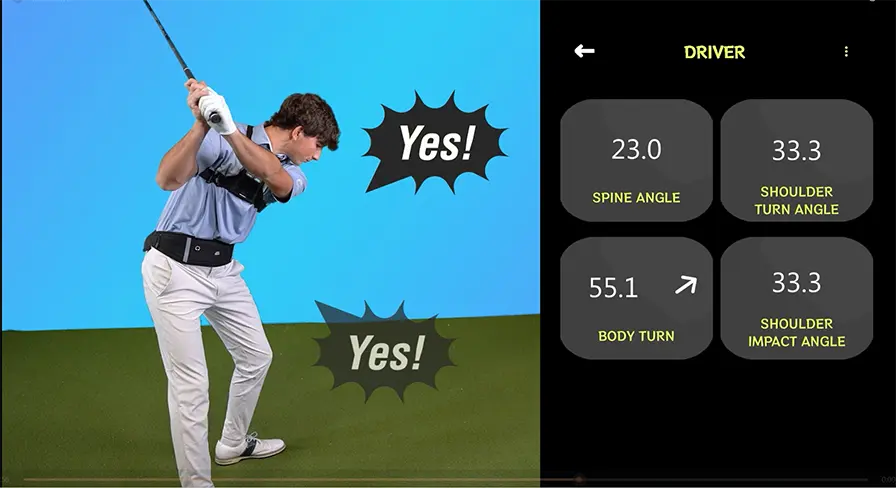
Always use the SpineAlign Golf App to set up at the correct
spine angle for the chosen club.
Overactive Arms and Shoulders
If your downswing starts with your shoulders spinning open, your lower body reacts poorly.
The hips slide forward instead of rotating at the correct angle.
Use the SpineAlign Golf App with the hip belt to practice proper lower body turn.
Equipment Issues
Clubs that are too long or lie angles that don’t fit can encourage standing up.
Sometimes the problem isn’t just your swing — it’s your tools.
How to Diagnose Early Extension in Your Swing
Ball Flight Clues
Watch for:
- Pushes to the right
- Snap hooks
- Thin shots
- High weak fades
Inconsistent contact is a major clue.
Video Checkpoints
Film yourself from down-the-line.
Draw a line against your backside at address and middle of your spine. See if your hips move away from that line toward the ball in the downswing. The video will also show that you have lost your spine angle, which is the most important evidence.
Divot and Contact Patterns
If your divots are inconsistent in depth or direction, posture breakdown is always the cause.
Step-by-Step Fix for Early Extension
Step 1 – Fix Your Setup
Start with:
- Balanced weight (not on your toes)
- Proper hip hinge
- Relaxed arms
- SpineAlign Golf App
Good swings start before you move the club.
Step 2 – Improve Rotation in the Backswing
Turn your shoulders into SYNC with the lower body.
Turn your shoulders at the correct angle using the SpineAlign Golf App, while making sure that your legs and hips are in sync.
Always allow your hips to rotate naturally! Use the SpineAlign Golf App to learn ideal hip angle turn.
Feel pressure move into your trail heel (right leg for right-handed golfer) — not your toes.
Step 3 – Create Space in the Downswing
Feel your trail hip (right hip for right-handed golfer) move back up and behind as your right leg firmly “postures” 75% of your weight. Allow the lead hip (left hip for right-handed golfer) to move down towards the center of your stance by allowing left knee to bend outwards and towards center.
Step 4 – Maintain Posture Through Impact
Imagine keeping your chest over the ball longer.
Use the SpineAlign Golf App and practice quarter turns to learn how to maintain steady spine angle.
Keep your head steady. If your head lifts early, your body will follow.
The Best Drills to Eliminate Early Extension
The Windmill Drill
Our Windmill Drill, which is taught in our Academy, is the best practice for learning how to move your body and maintain posture. Use the SpineAlign Golf App while practicing the windmill to learn the audible feedback and angles of the swing.
This drill also helps you learn how to keep your head steady.
Make slow practice swings with your arms against a wall.
Then, use a club while a friend holding your head steady.
It looks funny. It works. Watch our Academy Lessons!
Chair or Wall Depth Drill
Place a chair behind you at address.
Keep your glutes in contact with it during the swing.
Lose contact? That’s early extension.
Slow-Motion Transition Drill
Some early extensions happen because golfers rush.
Slow down your transition.
Feel your lower body rotate while your upper body stays stable.
Mobility Exercises That Make Fixing It Easier
Hip Internal Rotation Work
Improving internal rotation gives your hips room to move properly.
Glute Activation
Strong glutes stabilize your pelvis.
Bridges and mini-band walks work great.
Thoracic Spine Mobility
A mobile upper back allows better shoulder turn without standing up.
What Happens When You Fix Early Extension
More Consistent Contact
Center-face strikes become normal.
Not lucky.
Better Ball Flight Control
Maintaining posture improves clubface control dramatically.
Increased Distance
Better rotation equals more power.
You’ll eliminate those high, weak shots instantly.
Improved Tempo
Standing up is a rushed move.
When you remove it, your swing becomes smoother and more repeatable.
Mental Cues That Actually Work
Sometimes one simple thought changes everything:
- “Left hip down.”
- “Rotate shoulders in sync with hips and legs.”
- “Chest steady.”
Find the one that clicks for you.
Final Thoughts on Early Extension
Early extension isn’t a permanent flaw. It’s a movement pattern your body adopted to compensate for something else.
Fix your fundamentals by using the SpineAlign Golf App and watching our Academy lessons.
Golf rewards efficiency. When your body rotates instead of standing up, everything feels easier.
Consistency. Distance. Control.
And that’s what we’re really chasing, right?