

Golf is a game of precision, consistency, and continuous refinement. The difference between an average player and a skilled golfer often lies in the ability to identify swing flaws and correct them immediately. Traditional practice methods rely on delayed feedback—reviewing video after practice or waiting for coaching sessions. However, SpineAlign’s modern technology has transformed training through real-time golf swing feedback, enabling golfers to analyze and adjust their swings instantly.
In this comprehensive guide, we explore how real-time swing feedback systems work, the technologies behind them, and how golfers can leverage these tools to dramatically improve accuracy, distance, and consistency on the course.
Understanding Real-Time Golf Swing Feedback
Real-time golf swing feedback often refers to systems and technologies that analyze a golfer’s swing and provide immediate insights into club positioning, speed, and impact conditions. Players receive quick data and visual cues that allow such basic feedback, but immediate correction is not provided by this technology.
These systems typically monitor critical swing metrics such as:
- Club path
- Swing tempo
- Clubface angle
- Ball speed
- Launch angle
- Attack angle
By analyzing these elements golfers can get an idea about what went wrong. However, the corrections required are left to guess work, without professional advice. Even coaching evaluation can often be imprecise.
Why Real-Time Feedback Transforms Golf Training
Traditional golf improvement relies heavily on repetition without precise insight. Players might hit hundreds of balls without understanding exactly why shots slice, hook, or lack distance. Real-time feedback eliminates this uncertainty. That’s where SpineAlign comes in.
Immediate Error Detection using SpineAlign AI Golf Coach
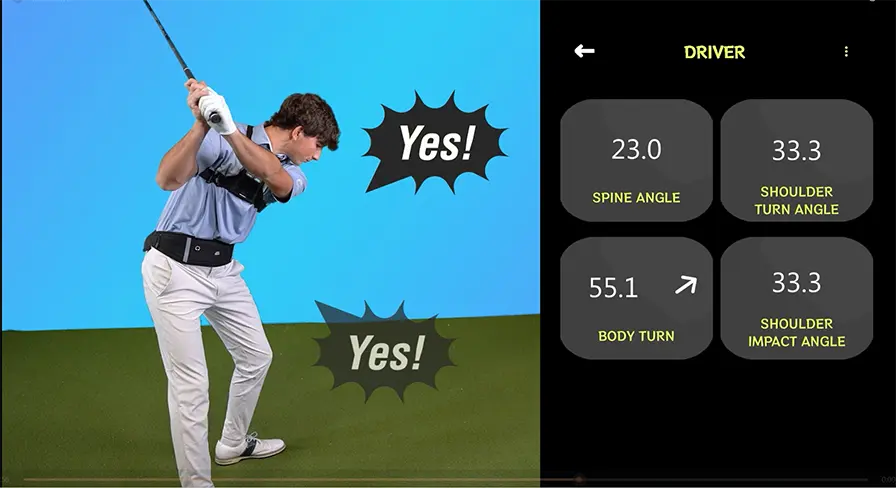
With instant swing feedback, golfers can identify technical flaws the moment they occur. For example, if the shoulders are turning incorrectly the App provides instant feedback.
Accelerated Skill Development
When players receive instant correction cues, they adjust their mechanics faster. Instead of reinforcing mistakes through repetition, each swing becomes a learning opportunity.
Enhanced Consistency
Consistency is the foundation of great golf. By TRACKING every swing, players develop repeatable swing patterns that lead to more predictable ball flight.
Key Technologies Behind Real-Time Golf Swing Feedback
Modern golf feedback systems integrate multiple technologies to deliver accurate and immediate insights.
Launch Monitors
Launch monitors measure ball and club data at the moment of impact. Using radar or photometric technology, these devices capture detailed performance metrics including:
- Ball speed
- Carry distance
- Launch angle
- Spin rate
- Clubhead speed
With real-time display screens, golfers instantly see how each adjustment affects ball flight. Using SpineAlign provides an AI coach to help make those adjustments much easier to understand and make. Swing improvement is much faster and better than ever.
High-Speed Motion Sensors
Wearable motion sensors attach to gloves, clubs, or the golfer’s body to capture 3D swing motion data. These sensors track movement patterns and provide instant biomechanical feedback such as:
- Wrist hinge timing
- Body rotation
- Swing plane alignment
- Tempo rhythm
This level of detail allows golfers to fine-tune mechanics with more precision. SpineAlign can be used with any of these technologies. The proper golf swing sequence taught by SpineAlign makes the swing corrections less dependent on these expensive technologies because it reduces the number of swing thoughts required to achieve an ideal golf shot.
AI-Powered Swing Analysis
Spinealign’s Artificial intelligence now plays a significant role in golf training. This AI analysis can identify patterns such as:
- Early extension
- Over-the-top swing path
- Poor weight transfer
- Incorrect hip rotation
- Wrong posture
- Incorrect lower body mechanics
Because the feedback appears immediately after each swing, players can correct issues before they become ingrained habits. No more guesswork!
Smart Cameras and Computer Vision
High-speed cameras capture swings from multiple angles while computer vision software analyzes body movement and club position. Visual overlays show ideal swing positions compared to the golfer’s actual motion, providing some intuition. These can be useful; however they are time consuming and do not provide corrective feedback during your swing. Analysis is also prone to user errors and judgement.
Essential Swing Metrics That Real-Time Feedback Tracks
To improve effectively, golfers must understand the key metrics that influence shot quality. Real-time feedback systems measure several critical swing parameters.
Club Path
Club path refers to the direction the club travels through impact relative to the target line. Incorrect club path is a primary cause of slices and hooks and is often caused by a breakdown of swing sequence mechanics, which can be corrected by using SpineAlign.
Understanding this allows golfers to adjust inside-out or outside-in swing paths instantly, improving ball direction and shot shape.
Clubface Angle
The orientation of the clubface at impact determines the starting direction of the ball. Even a slight misalignment can dramatically affect accuracy. Watching our Academy Lessons will help you to understand proper gripping and other factors that lead to incorrect face angles.
Swing Tempo
Tempo measures the timing and rhythm of the swing. Many amateur golfers swing too fast or inconsistently. SpineAlign’s Recording feature can be used to measure your tempo.
How Real-Time Feedback Improves Different Skill Levels by using SpineAlign
Beginner Golfers
New golfers often struggle with basic mechanics. Real-time feedback helps beginners quickly understand correct swing fundamentals, including posture, alignment, and lower body movement.
Instant visual cues reduce confusion and accelerate learning.
Intermediate Players
Intermediate golfers usually battle consistency issues. Real-time data highlights small mechanical errors that lead to inconsistent shots.
By correcting these flaws immediately, players build a more dependable swing.
Advanced Golfers
For advanced players, marginal gains can make a major difference. Real-time feedback enables micro-adjustments to optimize performance, fine-tuning launch conditions and ball flight patterns.
Even professional golfers use advanced feedback systems to maintain elite performance levels.
Best Practices for Using Real-Time Swing Feedback
To maximize the benefits of real-time swing analysis, golfers should follow structured practice strategies that are taught in our Academy.
Focus on One Adjustment at a Time
Attempting to fix multiple swing flaws simultaneously can lead to confusion. Instead, players should target a single improvement goal per session. Follow our Academy Lessons to learn the proper golf swing sequence.
Combine Data With Feel
While data provides clarity, successful golfers also develop strong swing feel. Use feedback to confirm sensations rather than replacing them entirely.
Record Progress Over Time
Tracking swing metrics across practice sessions reveals long-term improvement trends, helping golfers stay motivated and focused.
Integrate Feedback Into On-Course Practice
Practice sessions should simulate real playing conditions. Applying feedback while practicing different clubs and shot types ensures improvements transfer to actual gameplay.
Conclusion
Modern golfers no longer need to rely on guesswork during practice. Real-time golf swing feedback provides instant insights that accelerate learning, eliminate mechanical flaws, and improve consistency.