

If you’ve ever stood over an iron shot wondering why the ball went sideways instead of straight at the flag, you’re not alone. Using your “Irons in golf” is one of the most talked-about, debated, and misunderstood topics in the game and yet, getting your irons dialed in is arguably the fastest way to lower your handicap. Whether you’re a complete beginner who’s just joined a local club or a mid-handicapper looking to sharpen your approach game, understanding your irons from the ground up is going to transform the way you play.
What Exactly Is an Iron in Golf?
Irons will make or break your game. Most of your iron shots will be primarily for approach shots, tee shots on short holes, and a variety of other situations where precision and control matter more than raw distance. Irons have a flat, angled clubface and are typically numbered from 1 through 9. Lower numbers (3-6) produce flat trajectory, longer shots. Higher numbered irons (7-9) produce shorter, higher trajectory shots with more spin. They’re the workhorses of any golf bag, and most rounds are largely won or lost with how well a golfer strikes their irons.
You’ll hear players talk about their “iron game” as a separate skill set from driving or putting, and that’s genuinely the case. A well-struck iron shot that lands close to the pin sets up birdie opportunities. A poor iron shot that misses the green means scrambling for par or worse.
The Anatomy of a Golf Iron
Understanding what you’re holding is the first step to using it properly. A golf iron consists of several key components, each playing a distinct role in how the club performs.
The clubhead is the business end of the club. It’s what makes contact with the ball, and its design including the loft angle, face size, and sole width determines the shot shape and trajectory. The face of the clubhead is grooved, and those grooves are critical: they grip the ball at impact, generating the backspin that makes the ball fly high and stop quickly on the green.
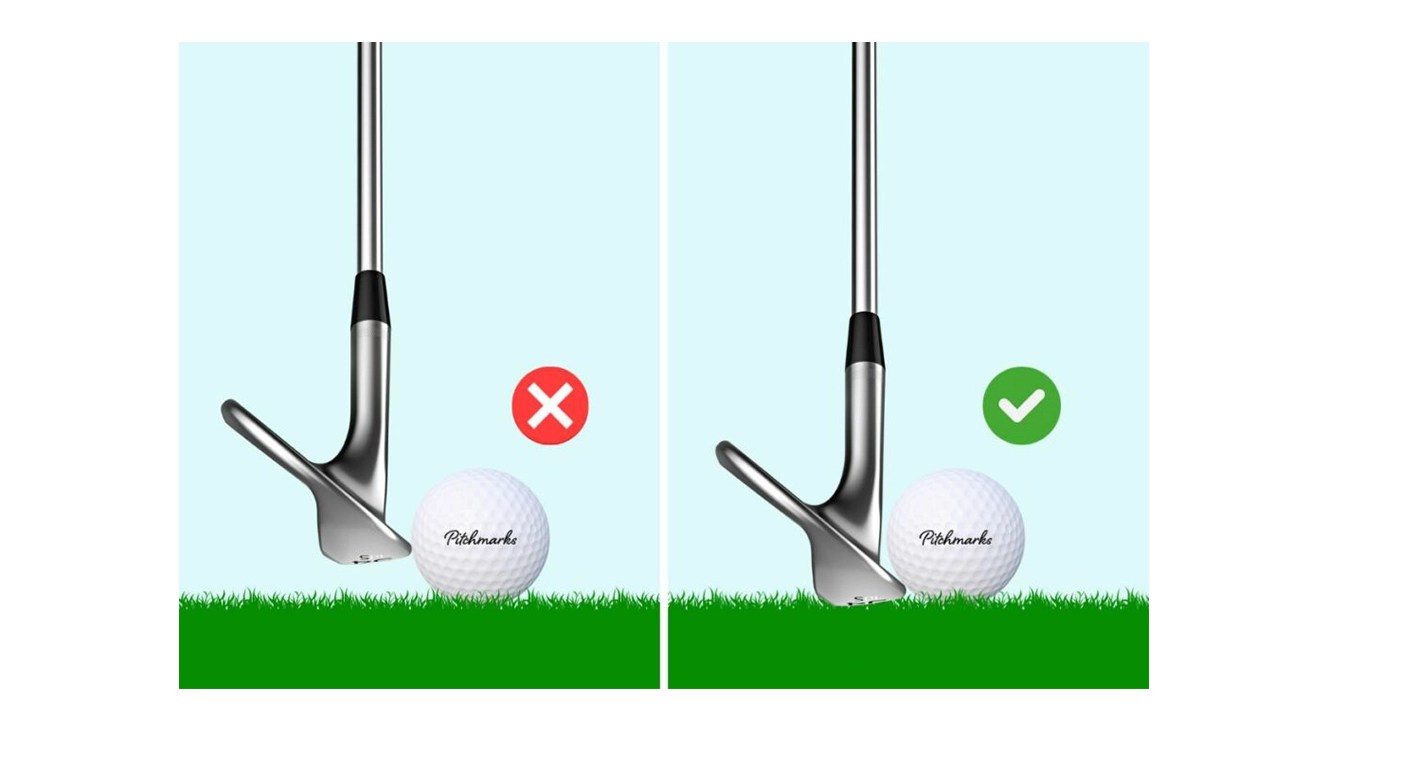
The hosel connects the shaft to the clubhead. Its length and angle affect the lie angle of the club that’s the angle between the shaft and the ground when the club is soled properly. Getting the lie angle right is a big deal in club fitting, because a lie angle that’s too upright or too flat will send your shots off line even with a perfect swing.
The shaft connects the grip to the clubhead and comes in various materials primarily steel and graphite and flex ratings. Shaft selection is genuinely game-changing, and we’ll dig into that in detail later.
Finally, the grip is where your hands meet the club. It might seem like a minor detail, but grip size affects how freely your wrists can release through impact, and worn-out grips are one of the most overlooked causes of poor ball-striking.
How Irons Differ from Woods and Hybrids
This is a question that trips up beginners all the time, so let’s clear it up. Woods have larger, rounded heads designed to sweep the ball off the turf or tee. Drivers have even larger heads and are designed for an ascending angle of attack. Hybrids are a cross between irons and woods they have a wider sole and more forgiveness, making them easier to hit than long irons but offering more control than fairway woods.
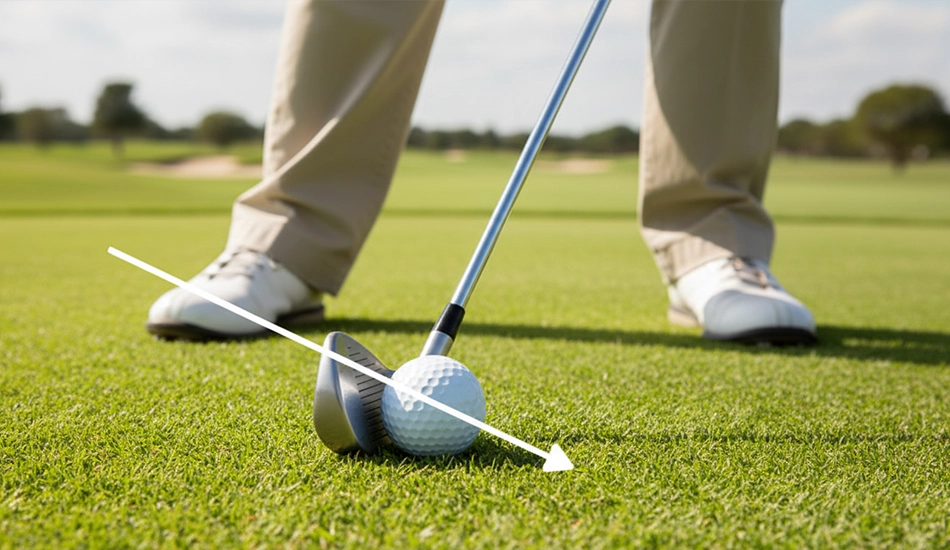
Irons, by contrast, are designed to be hit with a descending blow striking the ball first and then taking a divot from the turf. This compresses the ball against the face, creates backspin, and produces that satisfying, penetrating ball flight that good iron players are known for. It’s a fundamentally different motion from hitting a driver, which is why the two skills develop somewhat independently.
Types of Golf Irons Explained
A standard set of irons covers a wide range of distances and situations. It’s worth knowing what each iron in your set is designed to do, because using the wrong club for the situation is one of the most common amateur mistakes.
Long Irons (1–4): Distance and Workability
Long irons (2, 3, and 4) are the lowest-lofted irons in the set, producing the lowest launch angle and the most distance. A 4-iron typically carries around 170–185 yards for a mid-handicapper, while a 2-iron could cover 220+ yards in the hands of a skilled player.
These clubs are notoriously difficult to hit well. Their lower loft means there’s less margin for error a slightly mis-struck long iron produces a much worse result than a mis-struck 8-iron. Many amateur golfers, and even some professionals, have replaced their 2 and 3-irons with hybrid clubs that offer similar distances with far more forgiveness. That said, better players who can compress the ball consistently often keep a 3 or 4-iron in the bag for its workability the ability to shape shots left or right intentionally.
Mid Irons (5–7): The Backbone of Your Bag
The 5, 6, and 7-irons sit in the middle of the set and are genuinely the most-used irons for most golfers. These clubs produce a mid-trajectory ball flight with a good combination of distance and control. A 7-iron is often described as the most important club in the bag it’s the club most used in practice sessions, most commonly measured during club fittings, and the benchmark by which many golfers judge their ball-striking.
Mid irons are your go-to clubs for approach shots from 130 to 190 yards, depending on your ability level. They’re versatile enough to use from the fairway, the rough, or even the tee on shorter par-3 holes. Getting comfortable and consistent with your mid irons is genuinely one of the highest-return investments you can make in your game.
Short Irons (8–9) and Pitching Wedge
Short irons and the pitching wedge are the scoring clubs of the set. With their higher loft angles typically 40–46 degrees for a pitching wedge they launch the ball steeply and land it softly, making them ideal for approach shots where you need the ball to stop quickly on the green.
A 9-iron typically carries between 110 and 140 yards for most amateur golfers, while the pitching wedge lands somewhere between 100 and 130 yards. These clubs generate significant backspin sometimes enough to actually pull the ball back toward the hole after it lands and are the primary tools for what golfers call greenside approach play.
Accuracy, not distance, is the priority with short irons. When you’ve got a 9-iron in your hand, you should be thinking about where you want the ball to land, what the wind’s doing, and whether you need to take something off the shot or hit it full. Distance control with short irons is a skill worth developing deliberately.
Mastering Iron Swing Fundamentals
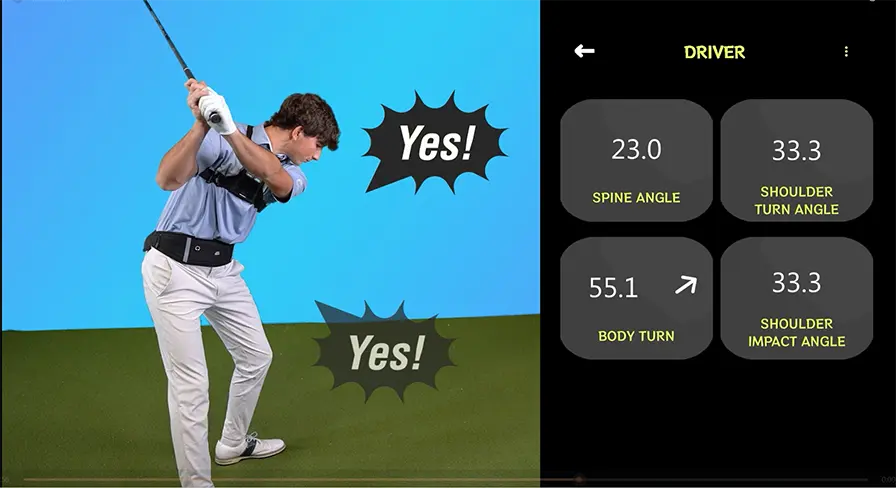
You can have the best irons money can buy, but if your swing fundamentals are off, you’re going to struggle. SpineAlign AI Golf Coach takes the guesswork out of your swing fundamentals. Let’s talk about what good iron technique looks like.
The Correct Setup and Stance for Iron Shots
Everything in golf starts with the setup, and iron shots are no exception. Getting your setup right creates the conditions for a repeatable, consistent swing and it’s something you can work on away from the course without hitting a single ball.
Ball position for irons should be in the middle of your stance for short irons, moving progressively forward (toward your front foot) as the clubs get longer. A 9-iron sits roughly in the centre; a 4-iron sits perhaps two ball widths inside the front heel. This progressive ball position naturally accommodates the change in swing arc length and ensures the club reaches the low point of its arc at the right moment.
Stance width should be roughly shoulder-width for mid irons, narrowing slightly for short irons and widening slightly for long irons. A wider stance provides a more stable base for a longer, more powerful swing; a narrower stance allows freer hip rotation for the shorter, more controlled swings used with short irons.
Posture is critical. You want a slight forward tilt from the hips (not the waist), soft knees, and your weight balanced evenly between both feet at address. Your arms should hang naturally from your shoulders not reaching for the ball or standing too close. The butt of the club should sit a fist’s width away from your front thigh.
SpineAlign AI Golf Coach helps to set you up correctly!
Grip pressure is something most instruction books mention but few golfers get right. You want enough pressure to control the club but loose enough that you’re not creating tension in your forearms. Think about a 4 on a scale of 1 to 10 firm enough, but relaxed.
Creating a Consistent Ball-Then-Turf Contact
If there’s one concept that separates good iron players from poor ones, it’s the ability to hit the ball before the turf consistently. When the clubhead strikes the ball first and then continues into the ground to take a divot, the ball is compressed against the face, maximum spin is generated, and the loft of the club works as designed.
When golfers hit the turf before the ball the classic “fat shot” the ground absorbs energy that should be going into the ball, producing a weak, short shot that usually misses the green by a significant margin. It’s frustrating, and it’s incredibly common.
The key to ball-first contact is maintaining the forward lean of the shaft through impact. At address, the shaft should be leaning slightly toward the target hands ahead of the ball. Through impact, that forward lean must be preserved. If you allow your wrists to scoop the ball upward in an attempt to help it get airborne, the club’s low point moves backward, behind the ball, and you’re going to hit the turf first. Paradoxically, the way to get the ball up in the air is to hit down on it.
Why Hitting Down on the Ball Produces Better Iron Shots
This concept is counterintuitive enough that it’s worth dwelling on. The loft built into the clubface is what launches the ball upward you don’t need to add loft by scooping. In fact, adding loft by scooping actually reduces the effective loft for a split second at impact (because the shaft is leaning backward), which produces a low, thin shot rather than the high, soft shot you were trying to hit.
When you hit down on the ball with a descending blow, you’re compressing the ball between the face and the ground. The ball deforms slightly, grips the grooves, loads with spin, and launches off the face on a high, consistent trajectory. The divot you take after the ball is the evidence that you’ve done it right a divot in front of where the ball was sitting, pointing at the target.
SpineAlign AI Golf Coach helps you master your swing fundamentals so that you can effectively create that descending iron hit!
Iron Distance Chart: What to Expect at Every Level
One of the most common sources of confusion for golfers is how far they should hit each iron. The truth is that distances vary enormously between skill levels, and comparing your distances to a tour professional’s is both meaningless and counterproductive. Here’s a realistic guide based on typical amateur swing speeds:
| Iron | Beginner (Carry) | Mid-Handicap (Carry) | Low-Handicap (Carry) | Tour Pro (Carry) |
| 3-iron | 130–150 yds | 160–180 yds | 185–200 yds | 210–225 yds |
| 4-iron | 120–140 yds | 150–170 yds | 175–190 yds | 200–215 yds |
| 5-iron | 110–130 yds | 140–160 yds | 165–180 yds | 190–205 yds |
| 6-iron | 100–120 yds | 130–150 yds | 155–170 yds | 180–195 yds |
| 7-iron | 90–110 yds | 120–140 yds | 145–160 yds | 170–185 yds |
| 8-iron | 80–100 yds | 110–130 yds | 135–150 yds | 160–175 yds |
| 9-iron | 70–90 yds | 100–120 yds | 125–140 yds | 150–165 yds |
| PW | 60–80 yds | 90–110 yds | 115–130 yds | 140–155 yds |
These are carry distances the distance the ball travels through the air before landing. Total distance (including roll) will be somewhat longer, depending on the firmness of the ground and the launch conditions. What matters most isn’t matching someone else’s distances, but knowing your distances accurately enough to choose the right club for every situation.
Conclusion
The iron in golf is far more than just a metal club. it’s the instrument through which most of your scoring happens, the tool that defines your approach game, and the part of your equipment that most rewards investment in both quality and technique. Every aspect of your iron game is an opportunity to improve.
The most important takeaway is that there’s no one-size-fits-all answer when it comes to irons. The best iron is the one that’s fitted to your specific swing, suits your skill level, and gives you confidence when you stand over the ball. With the technology available today from sophisticated launch monitors to an enormous range of head designs, shaft profiles, and customisation options there’s genuinely never been a better time to invest in understanding and improving your iron game.
For further reading on iron fitting and swing improvement, the Golf Digest Equipment Guide (golfdigest.com) is an excellent resource that’s updated regularly with testing data and expert analysis. also you can checkout our regularly updated blog posts
Take your time, get fitted, practice with purpose, and enjoy the process. Lower scores with your irons are absolutely within reach.